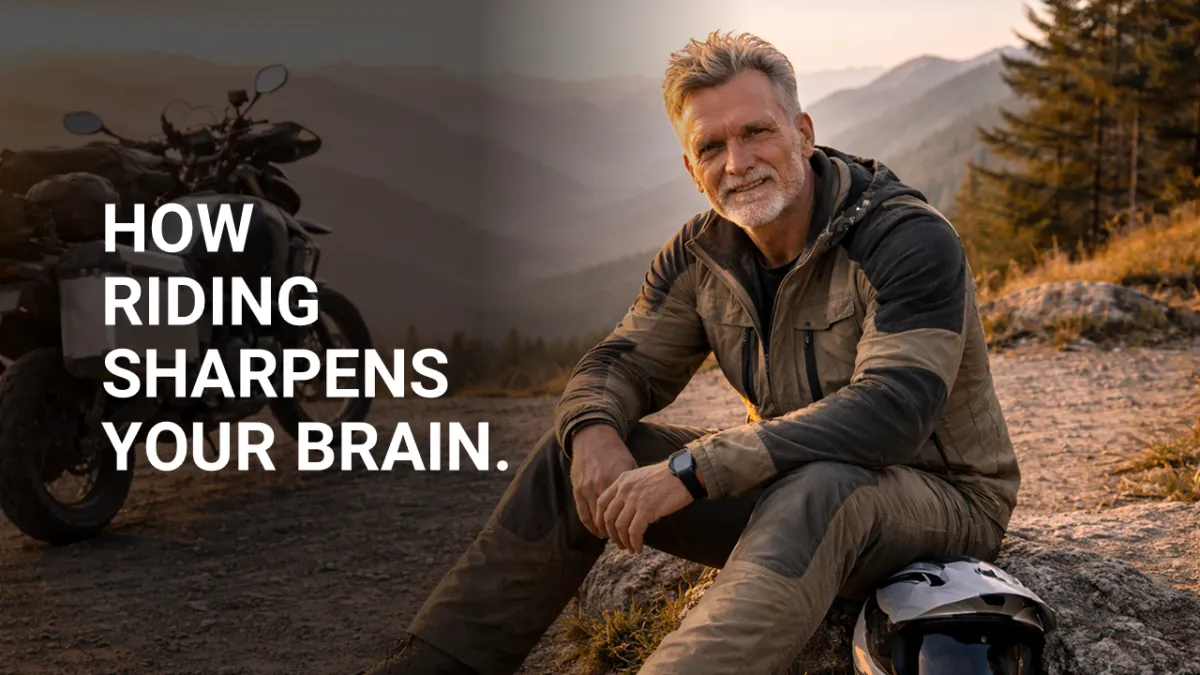
Motorcycling Shapes a Healthy Brain (1.07)

Every ride feels like freedom. The engine’s hum, the road unfolding ahead, the quiet focus that settles in. Yet beneath that familiar feeling lies something deeper. A subtle mental shift happens while riding, one most riders sense instinctively but rarely stop to question.
For years, scientists believed mental sharpness came from puzzles, apps, and brain games. But real life told a different story. One everyday activity combines focus, balance, decision-making, and flow in a way no screen-based training ever fully matched.
What if riding isn’t just an escape from noise, but a workout for the mind? What processes switch on when tires meet asphalt that quietly reshape attention, reaction speed, and presence? The answer sits somewhere between movement, awareness, and rhythm.
In the early 2000s, brain-training games promised sharper thinking. Then a neuroscientist uncovered something unexpected - an activity that boosted cognitive performance dramatically in weeks. Not apps. Not puzzles. Something far more physical. And far more familiar.
Why Riding Sharpens Your Brain
The road has a way of clearing your head. Not the polite kind of clearing, like a checklist finally done, but the deep kind. The kind where the noise fades, your breath settles, and the world narrows to what matters right now. Bars. Throttle. Horizon.
Most riders know this feeling. We struggle to explain it to people who do not ride. We talk about freedom, flow, presence. But those words often sound poetic, even vague.
What if that feeling is not just emotional.What if it is biological.
Recent neuroscience suggests that riding a motorcycle does not only calm the mind in the moment. It actively reshapes the brain over time. Riding may not just feel good. It may literally make you sharper.
From Brain Games to Real Roads
In the early 2000s, a small Nintendo game surprised the world. Brain Age sold more than 33 million copies and sparked a global conversation about cognitive training. The idea was simple and radical at the same time. If you challenge your brain regularly, you do not just maintain mental ability. You improve it.
Behind that game was Dr. Ryuta Kawashima, one of Japan’s most respected neuroscientists. His life’s work focuses on neuroplasticity and cognitive aging. The ability of the brain to change, adapt, and grow based on what we do repeatedly.
In 2009, Kawashima made a discovery that surprised even him. An activity improved cognitive performance by more than 50 percent in just two months.
Not apps. Not puzzles. Not meditation. It's Motorcycle riding.
Even more surprising, these changes were not temporary. As long as riding continued, the brain adaptations appeared to last.
Short Rides, Long Effects
A separate study from UCLA looked at what happens during and immediately after a ride. The results were striking. Just 20 minutes of riding led to a 28 percent reduction in stress hormones. Riders showed improved focus, heightened sensory awareness, and entry into a flow state.
That study captured the short-term effect. The mental reset many of us feel after a ride.
Kawashima asked a different question. What happens if you ride regularly for months. Not the immediate calm, but long-term adaptation. Does the brain physically change.
Together, these studies tell a complete story. Riding delivers immediate relief and long-term transformation at the same time.

A Scientist Who Would Not Gamble His Reputation
Kawashima is not a fringe researcher chasing headlines. He directs the Institute of Development, Aging, and Cancer at Tohoku University. His reputation rests on peer-reviewed science.
When Yamaha Motor Company approached him in 2009, they asked a simple question riders had been asking for decades. Does riding a motorcycle stimulate the brain differently than driving a car.
Yes, Yamaha funded the research. But they did not control the results. Kawashima insisted on full scientific independence. If the data showed nothing, nothing would be published.
That matters. This was not marketing. It was neuroscience.
Inside the Study
The experiment was carefully designed. Researchers recruited 22 men in their 40s and 50s. All held motorcycle licenses. None had ridden in at least ten years.
This detail is crucial. It showed that the brain can rebuild these pathways even after long inactivity.
Participants were split into two groups. One group rode motorcycles daily for two months. Commuting. Errands. Normal riding. The control group did not ride and continued life as usual.
Before and after the two-month period, researchers tested memory, spatial reasoning, concentration, and information processing speed. Brain imaging compared motorcycle riding with driving a car, focusing on the prefrontal cortex, the brain’s decision-making center.
Fifty Percent Is Not a Rounding Error
The results were impossible to ignore. Riders showed dramatic improvements across multiple cognitive tests. On a demanding memory task involving reversing number sequences, scores improved by more than 50 percent.
Spatial reasoning improved. Concentration increased. Processing speed rose across the board.
The control group showed minor improvement from taking the tests twice, a known practice effect. But nothing close to the riding group.
These gains were statistically significant. Not subjective. Measured.

Why the Brain Loves Riding
Brain imaging revealed the reason. When riding a motorcycle, the prefrontal cortex lights up. Decision-making, memory, focus, and problem-solving engage fully.
Driving a modern car barely activates these regions. Cars handle complexity for us. Stability systems. Cruise control. Climate control.
On a motorcycle, you are the system.
You balance. You adjust body position. You read the road. You predict traffic. You process speed, lean angle, weather, and grip all at once.
It is a continuous cognitive workout. The brain responds by adapting, strengthening the circuits you use most.
Driving becomes passive. Riding stays active.
Neuroplasticity on Two Wheels
Neuroplasticity explains it all. The brain is not fixed. It reallocates resources based on repeated demand.
Musicians develop larger auditory regions. Gamers enhance visual reaction circuits. Motorcyclists strengthen prefrontal activity, spatial processing, and decision-making pathways.
What makes this study remarkable is the age of the participants. Cognitive decline typically accelerates after 40. These riders did not merely slow decline. They improved.
That suggests riding may reverse aspects of age-related decline rather than simply delay it.
Therapy and Training at Once
The UCLA study shows what riding does now. Reduced stress. Mental clarity. Flow. The Kawashima study shows what riding does over time. Stronger memory. Sharper focus. Resilient cognition.
Together, they explain why riders talk about riding the way they do. We are not escaping life. We are engaging it fully.
Every ride is therapy and training at the same time.
A Reality Check for New Riders
There is an important caveat. The study involved returning riders, not beginners.
New riders operate in survival mode. Stress dominates. Flow comes later.
The brain benefits emerge once fundamentals are mastered. Training, proper gear, and skill matter. Competent riding builds cognition. Fear-based riding does not.
The Real Payoff
Riding does not just feel good today. It compounds. That clarity after a ride is not imaginary. It is neural adaptation in progress.
Riding is not reckless indulgence. It is one of the most mentally demanding and neurologically rewarding activities a human can do.
Two months. That is all it took in the study.
Five Takeaways for Riders
Before we list the takeaways, remember this. Riding does not need to be justified. But it can be understood. And understanding deepens appreciation.
1. Ride consistently, not occasionally. The brain adapts through repetition. Regular riding builds stronger cognitive pathways than sporadic trips.
2. Focus on skill, not speed. Flow emerges from competence. Training unlocks the mental benefits.
3. Treat riding as mental hygiene. A ride is not wasted time. It is a reset for stress and focus.
4. Ride mindfully. Awareness amplifies cognitive engagement. Stay present, not distracted.
5. Think long term. Every ride invests in future clarity, not just today’s escape.
These are not rules. They are invitations. Invitations to ride with intention and awareness.
Closing Thoughts
The road gives us stories. But it also gives us structure. Riding does not take us away from life. It sharpens us for it.
Science now confirms what riders have always felt. Riding makes us calmer, sharper, and more present. Not just in the moment. Over time.
If you ride, you are already training your brain. If you stopped riding, the pathways can return. Two months was enough.
That might be the most surprising part of all.
Fred, Jessi & iFred - On the Road for You
This is Fred & Jessi, with iFred. We're on the road, living free and sharing our adventures. Fred rides, Jessi carries, and iFred connects the stories.
This time, our journey taught us about how riding reshapes the brain, powered by the freedom from My Easy Side Business.
The Studies: What Motorcycling Really Does to your Brain.
#1 University of California, 2021.
Motorcycling isn’t just a feeling - it’s science. A UCLA study showed that just 20 minutes of riding drops stress hormones by 28% while increasing focus, alertness, and calm at the same time. Earlier research by Ryuta Kawashima found that regular riding improves memory, concentration, and spatial awareness within two months. Riding forces full presence, quiets mental noise, boosts mood, lightly trains the body, and builds connection through community - making it a powerful, real-world reset for brain and mental health.
#2 University of Tokyo, 2025.
Motorcycling isn’t just fun it measurably improves your brain. Research led by Ryuta Kawashima, creator of Brain Age, found that daily riding for two months boosted memory, focus, and processing speed by over 50%, even in men over 40. Brain scans showed strong activation of the prefrontal cortex, unlike driving a car. Combined with a UCLA study showing immediate stress reduction, riding delivers both short-term calm and long-term cognitive gains - making it one of the most powerful real-world brain workouts available.


